

About the Research
Until new medications become available for patients with congenital tooth agenesis
Plan
- 2020-2022 Humanized antibody research and development
(Demonstration experiment of target model, preliminary toxicity test) - 2022-2023 Non-clinical safety studies
(Preparation of GMP formulations, planning of clinical trials)
- FIH (First-In-Human) trial
- 2024-2025 P1 Study
(Safety confirmation and optimal dose identification by gradually increasing the dose) - 2025-2028 P2a and P2b studies
(Confirmation of efficacy and safety at optimum volume) - 2027-2029 P3 Study
(Increase patient numbers, validate efficacy and safety)
- 2029 Application for national approval to the government and review by experts
- 2030 Launched as a prescription Medication in the domestic market
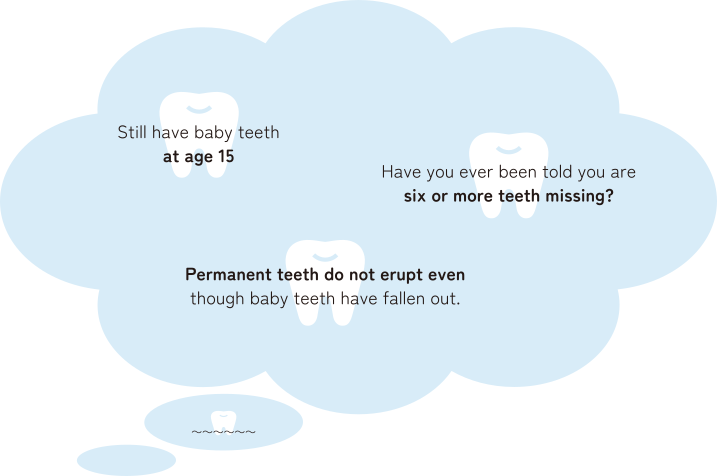
If any of the following ring a bell...
If you or a family member has any of the following, you may have congenital tooth agenesis

What is registry registration…
This is a clinical trial candidate registration for patients estimated to be from about 5 to 60 years old with congenital tooth agenesis characterized by variation in the number of teeth, and their families. Using genomic DNA, analysis of genes related to the determination of the number of teeth will be conducted to accumulate data.
Genomic DNA is a term used to describe chromosomal DNA. genome (gene), DNA (deoxyribonucleic acid).
What is a clinical trial…
A clinical trial is a study to investigate the safety and efficacy of a newly developed medication
(candidate).
Clinical trials are broadly divided into three steps, and the subjects targeted for each step are
different.
★What is an FIH trial・・・
Phase I clinical trial: The stage of testing on humans after safety and efficacy have been confirmed in
animal tests,
called "First in human."
The first step will involve healthy male adults (aged 30-65 years).
The second step is to target people who are likely to see a certain level of benefit.
(Targeted at
children aged 2 to 7 with four or more congenital tooth agenesis from among the registry participants)
In the third step, the majority of registry registrants become the subjects.
★In the future, we aim to expand the scope of application to include people with three or fewer congenital
tooth
agenesis.
TOP